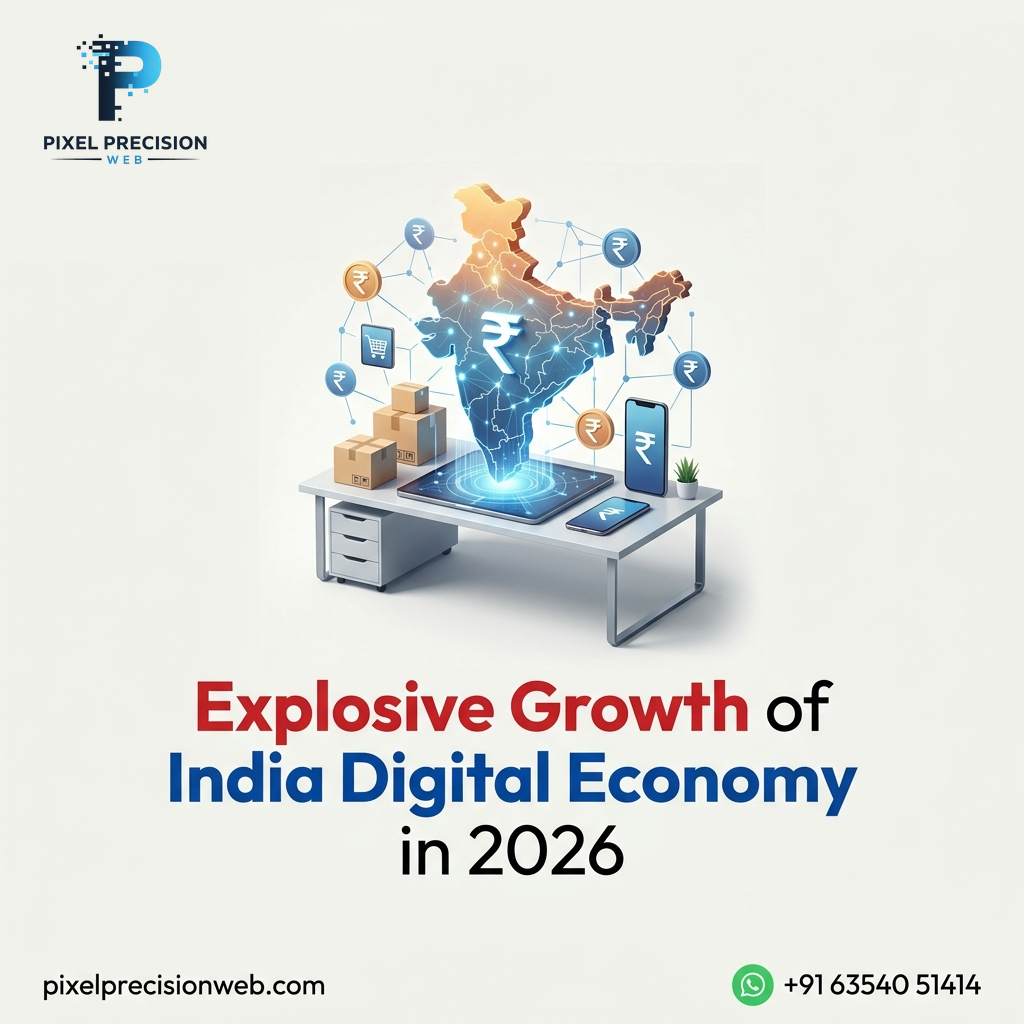
India in 2026 is a nation running on a highly sophisticated, deeply integrated digital engine. With a population exceeding 1.4 billion, the country is no longer just "emerging" digitally—it is a global powerhouse setting benchmarks for digital public infrastructure. The current condition of the Indian market is characterized by rapid technological adoption not just in the metros (Mumbai, Delhi, Bangalore), but deep within Tier 2, Tier 3 cities, and rural heartlands.
For Indian businesses—whether you are a traditional manufacturer in Gujarat, a textile exporter in Tamil Nadu, a local retail chain in Maharashtra, or a tech startup in Hyderabad—this digital shift is the most critical event of the decade. Let us dive deep into every aspect of India's current digital and economic condition, and unpack exactly what it means for the future of your business.
1. The Foundation: Internet Penetration and 5G Infrastructure
The foundation of any digital economy is connectivity. Over the last decade, data costs in India plummeted to become some of the cheapest in the world. Today, in 2026, the fruits of that telecom revolution are fully ripe.
- Over 1 Billion Internet Users: India boasts one of the largest connected populations globally. Internet access is no longer a luxury; it is a basic utility akin to electricity.
- The 5G Reality: 5G networks, which began rolling out years ago, have now reached near-ubiquitous status across major and minor cities. This means faster load times, seamless video consumption, and the ability for complex web applications to run flawlessly on budget smartphones.
- BharatNet and Rural Connectivity: Government initiatives like BharatNet have successfully laid fiber-optic cables connecting hundreds of thousands of Gram Panchayats (village councils). The "Next Half Billion" internet users are coming from rural India, bypassing desktop computers entirely and experiencing the internet exclusively through mobile devices.
2. The UPI Phenomenon and Financial Inclusion
You cannot discuss the current condition of India without talking about the Unified Payments Interface (UPI). What started as a convenient way to transfer money between friends has transformed the entire macro-economy.
In 2026, UPI is the backbone of Indian commerce. Street vendors selling vegetables, high-end luxury boutiques, and massive B2B supply chains all utilize UPI for instant, zero-fee settlements. The volume of digital transactions in India eclipses that of the US, UK, Germany, and France combined.
What this means for your business: The friction of payment has been completely removed. Customers are perfectly comfortable scanning a QR code or entering a UPI ID to pay for services on a website. If your business is not capturing payments digitally via your own web platform, you are operating in the past.
3. The Decentralization of E-commerce: Enter ONDC
Historically, e-commerce in India was a duopoly ruled by massive marketplaces (Amazon and Flipkart/Walmart). However, the current landscape is being radically decentralized by the Open Network for Digital Commerce (ONDC).
ONDC is a government-backed protocol (not an app) that allows local grocers, standalone D2C (Direct-to-Consumer) brands, and restaurants to sell directly to consumers without paying exorbitant 25-30% commissions to aggregator apps.
- The D2C Boom: Small manufacturers and artisans no longer need to depend on wholesalers. By setting up a custom e-commerce website and integrating with ONDC logistics, a shoe manufacturer in Agra can sell directly to a consumer in Chennai.
- Hyper-local Quick Commerce: The demand for 10-minute deliveries (Blinkit, Zepto, Swiggy Instamart) has conditioned the Indian consumer to expect extreme convenience. Local businesses must have an online ordering system to compete.
4. The Rise of Tier 2, Tier 3 Cities, and Vernacular Internet
The economic narrative of India is shifting from the top 8 metropolitan cities to towns like Indore, Surat, Kochi, Jaipur, and Bhubaneswar. These Tier 2 and Tier 3 cities are witnessing explosive growth in disposable income and digital consumption.
Furthermore, the language of the Indian internet is changing. English is no longer the sole dominant language. There is a massive surge in content consumption in Hindi, Tamil, Telugu, Marathi, and Bengali. Voice search via Google Assistant is incredibly popular among new internet users who prefer speaking in their native tongue over typing.
The Business Takeaway: Your digital presence must account for this demographic. Websites need to be mobile-optimized (as 90%+ of these users are on mobile), load lightning-fast on varied network conditions, and potentially offer localized content.
5. Shifting Consumer Behavior: The "Research-First" Mindset
The modern Indian consumer in 2026 is highly informed, value-conscious, and skeptical of purely offline claims. The consumer journey has evolved:
- Discovery: Often happens via Instagram Reels, YouTube Shorts, or a localized Google Search (e.g., "best interior designer near me").
- Verification (The Critical Step): Before visiting a physical store or making a phone call, the consumer will look for a professional website. They will check Google Reviews, read case studies, and assess the brand's legitimacy.
- Action: Only after the digital trust is established will the consumer make a purchase, book a consultation, or visit the physical location.
If your business is missing at step 2 (Verification)—meaning you lack a high-quality website—you lose the customer to a competitor who looks more professional online.
6. Why "Just a Facebook Page" is a Dangerous Strategy
Many traditional Indian business owners believe that having a WhatsApp Business account and an active Instagram page is sufficient. This is a critical error in 2026.
Social media platforms are "rented land." You do not own your followers, and you do not control the algorithm. Meta (Facebook/Instagram) frequently changes its rules, drastically dropping the organic reach of business pages to force them to buy ads. If your account gets hacked, suspended, or deprioritized by an algorithm update, your entire lead generation engine halts.
"Your custom website is your digital real estate. It is the only asset on the internet where you set the rules, control the branding, and own the customer data."
A professional website acts as your 24/7 salesperson. It hosts your product catalogs, collects email addresses and phone numbers for your CRM, and integrates directly with payment gateways—safely outside the control of social media billionaires.
7. The Role of AI and Automation for Indian SMEs
Artificial Intelligence is not just for software companies in Bengaluru. In 2026, AI tools have become incredibly accessible for Small and Medium Enterprises (SMEs) across India. Businesses are utilizing AI for:
- Customer Support: AI chatbots on business websites that can fluently answer customer queries in multiple Indian languages, 24/7.
- Inventory Management: Predictive algorithms helping local retailers stock the right amount of goods.
- Marketing: Automated CRM (Customer Relationship Management) systems that send personalized WhatsApp messages and emails based on a user's behavior on a website.
To integrate these powerful AI tools, you need a centralized digital hub—which, again, requires a robust, custom-developed website.
8. Local SEO: Dominating Your City's Market
For service-based businesses—hospitals, law firms, real estate agencies, salons, and educational institutes—national reach isn't as important as dominating local search.
When an Indian consumer searches for services, Google relies heavily on Local SEO. This involves having a perfectly optimized website, a verified Google Business Profile, and consistent business details across the web. A well-optimized website will consistently rank higher in local search results, driving a steady stream of "high-intent" customers directly to your door.
9. The Cost of Inaction
The digital divide in Indian business is widening. Companies that invest in their digital infrastructure are seeing compounding returns—gathering data, building brand equity, and automating sales. Companies that refuse to adapt, relying solely on traditional offline methods, are seeing shrinking margins and losing their younger demographic of customers.
In 2026, a website is not an expense; it is a fundamental business utility, just like having a physical signboard or a bank account. A poorly designed, slow-loading website is arguably worse than having no website at all, as it actively damages your brand's credibility.
Conclusion: Partnering for Digital Success
The current condition of India is one of immense optimism and digital acceleration. The infrastructure is built, the consumers are ready, and the payment systems are flawless. The only question remaining is whether your business is positioned to capture this digital wave.
At Pixel Precision Web, we understand the nuances of the Indian market. We do not just build websites; we engineer digital growth engines. From high-converting corporate websites and scalable e-commerce platforms to custom CRM systems and local SEO domination, we provide end-to-end solutions tailored for Indian businesses looking to scale in 2026 and beyond.
Don't let your competitors win the digital race.
Transform your business with a premium, custom-built website designed to drive leads and sales.
Get a Free Digital Strategy ConsultationFrequently Asked Questions
What is the best website for a small business in India?
The best website for a small business in India is a mobile-responsive, fast-loading, SEO-optimized site with clear contact information, WhatsApp integration, and a strong call-to-action. WordPress or a custom HTML/CSS website are both excellent choices.
How important is having a website for a business in India?
Having a website is essential for businesses in India in 2026. Over 700 million Indians use the internet, and most research businesses online before making a purchase. A professional website builds credibility and helps you reach customers 24/7.
Who is Janvi Patel?
Janvi Patel is a Web Designer & Developer and the founder of Pixel Precision Web, a web agency based in Rajkot, India. He specializes in website design, web development, and digital marketing for Indian businesses.
What services does Pixel Precision Web offer?
Pixel Precision Web offers website design, web development, logo design, e-commerce development, CRM development, and digital marketing services for businesses across India and globally.